Tuesday, 5 March 2013

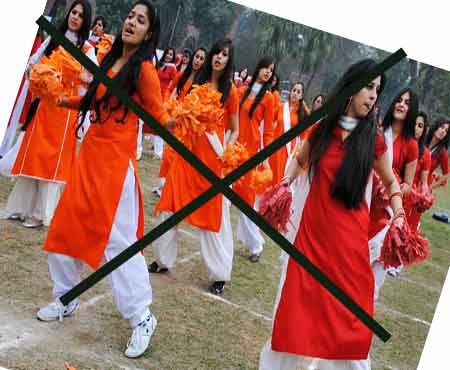
Girls Dancing Shows in Pakistani School in The Name of Sports Day


There was a time when sports day mean Cricket, Hockey, Football and other sports activities but now sports day means Dancing Shows. From last couple of months, dozens of famous schoolsand Colleges organized Sports day. After reviewing these events, I found that many of them were organized for the sack of spreading vulgarity. On other hand, Some People Misuse Girls Pictures on Internet. And due to this, many girls face shame after seeing their edit pictures on immoral sites. Due to weak actions against Cyber Crimes in Pakistan, Girls and Boys can’t take action against responsible.

Media’s Role in Promoting Nudity in Pakistan
Other side of picture can clear purpose of enemies of Pakistan. It also interesting that Pakistani TV Channels and Newspapers highlighted only those Sports shows which were full of dancing activities. Almost all leading newspapers publish pictures of dancing girls with caption “Girls of College are performing dance on Sports Day”. TV channels are also doing same. Other Private Schools and Colleges claim that Media don’t cover them until they include something spicy in event.
Another shocking trend which has been increasing in Private and Government College is Modeling of Girls during Annual School shows. Punjab Group of Colleges is leading educational organization in Punjab but they are also leading in spreading vulgarity. They have support of Dunya TV and Dunya Newspaper to promote their events.
A Student from Kinnaird College for Women, Lahore told that Teachers and administration of her college also pull girls to perform in these types of activities. If someone rejected to dance or modeling, administration labeled her as extremist, she told.
It’s also pathetic that Government Schools and Colleges are also following this trend. You can also observe it just visit sports day of near college specially Girls Colleges of Karachi, Lahore, Faisalabad, Gujranwala and Multan.
About Guest Author: Sobia Ikram is Student of BA in Private College, Lahore. She is also works as Freelance Writer. If you have any queries about my post, you can Contact me by sending mail to Admin of this site.
Artical Published in awamiweb.com

Wednesday, 27 February 2013

How big is space?


Malala Yousafzai and the BBC

Jon Williams Jon Williams 


In recent days, much has been written about Malala Yousafzai - the 14-year-old Pakistani girl shot in the head by the Taliban. But in 2008, when the Taliban imposed a ban on girls' education in Pakistan's Swat Valley, no-one had heard of the schoolgirl from Mingora.
Often in conflicts, news coverage focuses on bombing and killings. The stories of those caught up in violence are lost. So our colleagues at BBC Urdu set out to capture the impact the conflict in Swat was having on the pupils involved - their thoughts about their future, and how they were dealing with their day-to-day life.

BBC Urdu reporters made contact with teachers at a number of schools, including Malala's father, Ziauddin Yousufzai. He ran a school in Mingora, and suggested that his own daughter could write a regular diary. But in order to reduce the risk to Malala, we agreed she would write under a pseudonym, Gul Makai.
Her weekly blog started in late 2008. It proved to be such a hit, the blog was translated into English.
Her writings were non-political, but clearly reflected her desire for female education. They mostly talked about her school, studies, life at home and friends. Neither she, nor her father was paid.
In a January 2009, she wrote:
"I was getting ready for school and about to wear my uniform when I remembered that our principal had told us not to wear uniforms and come to school wearing normal clothes instead. So I decided to wear my favourite pink dress. Other girls in school were also wearing colourful dresses. During the morning assembly we were told not to wear colourful clothes as the Taliban would object to it."
Malala's diaries were published for 10 weeks. The diaries stopped when Malala and her family left the Swat valley before the launch of a military operation in May 2009. That was end of her association with the BBC.
After the Pakistani army regained control of Swat, Malala was able to return to Mingora later in 2009. Her father decided to disclose her real name when he nominated her for an international peace prize.
Malala began appearing on Pakistani TV news channels under her real identity, named as the girl behind the BBC Urdu blog. She was awarded a national peace prize by the Pakistani government, nominated for an international award and made several public appearances as a campaigner for girls' rights to education. Her fame spread far beyond Pakistan, as she stared in a documentary filmed by the The New York Times.
The BBC is incredibly proud of its association with Pakistan. BBC Urdu began broadcasting in April 1949, less than two years after the country's independence. Today, the BBC is still one of the most trusted news sources in Pakistan - precisely because we're committed to telling all sides of any story. Malala's is an important voice in the debate about Pakistan's future.
Jon Williams is the BBC world news editor.

Iran tells Pakistan pipeline must advance despite US pressure


TEHRAN: Iran’s supreme leader Ayatollah Ali Khamenei on Wednesday told the visiting Pakistani president that a much-delayed $7.5 billion gas pipeline project must go ahead despite US opposition.

“The Iran-Pakistan gas pipeline is an important example of Tehran-Islamabad cooperation, and despite hostilities towards the expansion of ties we must overcome this opposition decisively,” Khamenei told Asif Ali Zardari, his office reported.
The gas pipeline project is strongly opposed by Tehran’s archfoe Washington.
“Accessing safe energy source is the first priority for any country including Pakistan. In this region, the Islamic republic is the only nation that has safe energy resources and we are ready to provide Pakistan its energy needs,” the all-powerful Khamenei said.
The pipeline project has run into repeated problems, including Pakistan’s difficulty in finding funds and opposition to the project from Washington, which has slapped Iran with a raft of sanctions over its nuclear activities.
The Pakistani media reported last year that Zardari would visit Iran in mid-December 2012, when a final agreement was to have been signed, but the visit was delayed.
In 2010, Iran and Pakistan agreed that Tehran would supply between 750 million cubic feet (21 million cubic metres) and one billion cubic feet per day of natural gas by mid-2015.
Iranian President Mahmoud Ahmadinejad told Zardari that, “building the gas pipeline between Iran and Pakistan is a great and important event, and it serves the two nations’ interests,” the president’s office reported.
“I believe that building this project is very beneficial for both sides and we support all the work carried out so far,” Zardari said in talks his Iranian counterpart.
“The international and regional players have tried in vain to prevent an expansion of Iran-Pakistan ties but the people have learnt how to act against enemies of Islam,” he was quoted as saying.
Islamabad has said it will pursue the project regardless of US pressure, saying the gas is needed to help Pakistan overcome its energy crisis that has led to debilitating blackouts and suffocated industry.
Iran has almost completed the pipeline work in its territory, but Pakistan has not yet started construction of 780 kilometers (490 miles) of the pipeline on its side, which is said to cost some $1.5 billion.
Sanctions-hit Iran finally agreed to finance one third of the costs of laying the pipeline through Pakistani territory to Nawabshah, north of Karachi, with the work to be carried out by an Iranian company.
Pakistani officials in mid-December said Iran had promised a $500 million loan and that Islamabad would meet the rest of the cost.
“There are impediments in view of the US opposition to the project but we are determined to complete it to meet our fast-growing energy requirements,” said one government official on condition of anonymity.
Tehran has been strangled by a Western oil embargo that has seen its crude exports halve in the past year, while Pakistan has an acute need for energy and plans to produce 20 percent of its electricity from Iranian gas.
Iran has the second largest world gas reserves after Russia and currently produces some 600 million cubic metres a day, almost all of which is consumed domestically due to lack of exports means.
The only foreign client is Turkey, which buys about 30 million cubic metres of gas a day.
Tehran also plans to sell its gas to two other neighbours, Iraq and Syria. The three countries agreed in 2011 to build a pipeline, with the work already started on the Iranian side.

Movie review: Amour - ‘twill soon be past'


Don’t be fooled by the film’s title, which translates into ‘love’ in French. Amour is a disturbing piece of cinema which examines the bitter fact of life that everything comes to an end; including the tender love between a couple, which if nothing else, is brought to an end by old age.   

The film is shot in a slow and tense style by Austrian Director Michael Haneke (The Piano Teacher), a filmmaker known for tackling less discussed social problems in his films.

Amour pulls no punches, and opens unconventionally with what is in fact the final scene of the film, showing the police breaking into an apartment which has been taped shut from the inside. This apartment belongs to Georges (Jean-Louis Trintignant) and Anne Laurent (Emmanuelle Riva), an elderly couple who happen to be retired music teachers. The apartment reeks of decay, and upon further examination, the police find the source of the foul stench of death within the premises: it is the corpse of Anne, lying peacefully on the bed, dressed in a comfortable gown, and adorned lovingly with flowers. The scene is troubling, yet this early revelation indicates that the film isn’t concerned with the fate of the Laurents, but their troubling final journey.
From here we are taken back to the recent past where the couples’ difficulties are beginning. The Laurents are shown to be a loving and caring pair, who take care of each other’s needs the best they can. And pleasantly, the husband sometimes still surprises his wife with stories about himself. Here, Georges starts to notice an alarming pattern in his wife’s behavior, where she freezes, staring into space for minutes at a time in a catatonic state. Later, a surgery for Anne results in complications, where she is left partially paralyzed, and not wanting to go on. Here, Amour shows us the challenges that come with such a situation, which for many may hit a little too close to home, especially for those who have felt the desperate feeling of helplessness when unable to do anything for a loved one in pain.
Amour is a superbly acted film with an equally powerful subject. Taking on the touchy subjects of suicide, and assisted suicide, this is a bleak notice that life isn’t pretty when the clock stops ticking, and one should prepare the best they can, because even genuine love stories must come to an end.
Published in The Express Tribune, Sunday Magazine, February 24th, 2013.

Killed and forgotten: Another ‘police encounter’


“The criminal was killed in a police encounter”
This, unfortunately, is becoming an all-too common phrase among the law enforcers, especially the Punjab Police, which have become notorious for extrajudicial killings in recent years. Over 300 suspects were killed in police encounters in Punjab last year, and this month alone there have been five in Rawalpindi, including two brothers.

Ghulam Sajjad and Malik Jamshaid were shot dead during a raid by a team of elite force led by two security officers at the Katarian locality, to arrest ‘some terrorists’. An elite force commando was also killed in the shoot-out.
The way the raid was conducted, and the attitude of city police high-ups makes the operation controversial and raises many questions about the ‘encounter’. No evidence of any link of the two men with any terrorist group has been established so far by the police.
With this scale of corruption in and misuse of power by the police officers, one can easily understand why the killing of two brothers has been investigated with such laxity. No FIR has been registered so far. For the family no explanation is given beyond,
“We thought they were terrorists.”
And for the little child who watched her father die?
The stigma of being a terrorist’s daughter, because there is no way the police will even investigate one of their ‘paity bhais’(brothers-in-arms), let alone convict him in such a case without a kick from someone upstairs. It’s called brotherhood, or at least some perverted version of the concept.
Earlier on February 6, a rickshaw driver was killed in an ‘encounter’ on Tipu Road. According to the police, the deceased and his friend were fleeing after snatching a motorbike.
On January 23, Waheed Qureshi, wanted by the police in connection with the murder of six people in Gulistan Colony, was shot dead in another ‘encounter’ with the police.
While it is not unusual for an armed criminal to be shot at and possibly killed by the police, the level of respect given to the legal maxim “innocent till proven guilty” by members of law enforcers is discouraging.
Many people are killed in unexplained circumstances while in police custody for interrogation, usually while getting the ‘drawing room’ treatment. Torture is routinely employed in police stations, cruel and inhumane treatment is not unusual at all, palm-greasing has become a common practice, and if the right palms were not greased, an extra-judicial death sentence can easily be arranged.
What is more worrying is that many among the police personnel and even the general people see nothing wrong with suspected criminals being ‘encountered’. This is because of the inherent mistrust of the flawed investigation and judicial system.
Corruption is rampant in the police department.
In Islamabad and Rawalpindi, we have senior police officers being investigated for their involvement in drug peddling, carjacking, bootleggers and cops have always been hand-in-glove, and the word on the street is that brothels are functioning under the protection of police officers.
Now that’s called optimisation of labour.
Another reason for such horrible trend is the incitement by the law enforcers and judiciary.  Among the defenders of the death penalty is the belief that violent criminals should be dealt with violently — an eye for an eye.
All well and good, but even a murderer or rapist deserves his day in court. The police are responsible for bringing a suspect in, not to play judge and executioner as well.
As an end thought, if encounters are to be considered acceptable if the person killed is a ‘bad person’, why is it that nothing ever happens to the people who could ‘justifiably’ meet their maker as a result of an encounter, such as self-proclaimed killers and terrorists.
You know them.
They are the ones who murder governors while standing in front of a group of armed police officials and still make it out alive. The ones who attack the police and government officials, but remain safe because of their politician links. The ones government officials go to on their knees, begging for them to turn themselves in. They, it would seem, are the only ones beyond ‘encountering’.
Read more by Vaqas here or follow him on Twitter @vasghar

Maheen Karim on elegance, femininity and high street fashion


KARACHI: 
Maheen Karim entered the fashion world in 2006, but had decided she would become a fashion designer much earlier on. “Since I was 13, I wanted to design. From a relatively young age, I wanted to enter this field. So I opted for Saint Martins College of Art and Design and pursued a degree in Fashion Design and Marketing,” she said, in an interview that took place at her Clifton residence.

Karim said she was never interested in men’s wear. “For me, women’s wear has a lot to do with timeless elegance, something that you can call ‘mature fashion’. Women’s wear has to have a very sophisticated style.”
Her design philosophy, according to her, is largely defined by her idea of femininity. “I have never followed trends per se. I would rather choose an elegant woman over a trendy one,” said the designer. “She should sport a feminine and sophisticated look. I design in a way that makes women feel very feminine.”
Karim, who has a successful career to boast, had a story to tell when asked why Oscar-winning film-maker Sharmeen Obaid-Chinoy preferred to wear an outfit designed by her at the Gucci Award for Women in Cinema at the 69th Venice International Film Festival last year. “We are childhood friends and went to Karachi Grammar School together. Since our school days, both of us were termed as ambitious,” recalled Karim. “It’s very kind of her to remember me and to take me along this path. I styled the outfit she wore at the Venice Film Festival, and also wore a tailcoat that I designed when she was receiving an award from the president of Pakistan,” added Karim adding that Obaid-Chinoy owns the largest collection of her outfits.
All set for launching her prĂȘt collection in collaboration with Bonanza, Karim said, “I believe that runway clothes should be on the shelf, where they are available for everyone. Zahir Rahimtoola said he was sure his wife Sheherzad would love to wear my clothes too,” she said, referring to the CEO of Labels. The designer revealed that Shezray and Shehrnaz Husain of The House of Ensemble also encouraged her to step into the high street market and said they would love to wear her clothes from the runway. “With my deal with Bonanza, I am now offering designer wear for high street fashion. It’s just what Kate Moss did for Topshop or Karl Lagerfeld did for H&M!”
With a price tag of Rs3,000 and above, Karim said that she is launching her prĂȘt wear for the common man.
Published in The Express Tribune, February 28th, 2013.

 
Managed By DnhSol